Build the foundation for real reading.
Sounds of Success is a comprehensive phonemic awareness system that helps students develop accurate, automatic blending and segmenting skills—and apply them directly to reading and spelling.
Get your copy nowSounds of Success is a comprehensive phonemic awareness system that helps students develop accurate, automatic blending and segmenting skills—and apply them directly to reading and spelling.
Get your copy now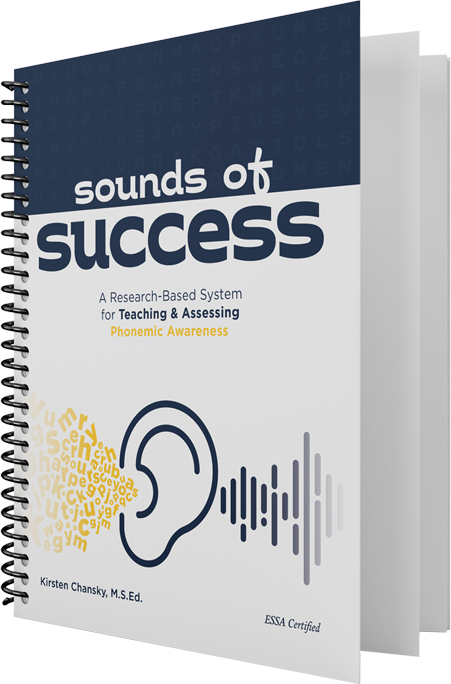
Feature article on Sounds of Success and early literacy outcomes
View ArticleFeature article on Sounds of Success and early literacy outcomes
View ArticleFrom Research to Routine: Effective Phonemic Awareness Instruction
June 17th, 2026 @ 1pm CDT
Centered on blending and segmenting—the two phonemic awareness skills most directly connected to reading and spelling success

Integrated with print—helping students build accuracy, automaticity, and transfer.

Each component works together to support responsive, research-based instruction across classroom, intervention, and individual settings.
Kindergarten & Grade 1 Classrooms / Early Intervention Settings / Students At Risk for Reading Difficulty / Older students needing foundational decoding support / Pre-K classrooms introducing reading foundations / and many more...
Sounds of Success draws on converging evidence from experimental, longitudinal, and meta-analytic research. Its instructional design aligns with the practices shown to most strongly support reading development. Grounded in decades of reading research and independently reviewed by Johns Hopkins University.
View The Research